Creating Safety Across Every Context

By Andrea Diamant of Encircle Safe
Early in my first year of teaching, a student disclosed something to me. As a first-year teacher with no training in safeguarding from my teacher education program or school beyond being a mandated reporter, I was terrified. I knew and followed the law and called social services.
The police came. The focus and investigation into the child and family unfolded as it was designed.
Looking back on that moment, I realize how limited my understanding of safeguarding was. Like many new educators, I'd been taught that I was required to respond to disclosures, my mandated requirement to protect, but nothing else. That experience shaped my commitment to understanding safeguarding not as a reactive procedure, but as a proactive, comprehensive approach to student wellbeing; a journey I'm still on today. What I'm sharing here reflects the areas that are pushing my thinking forward, the concepts and frameworks that continue to deepen my understanding of what it means to truly keep students safe.
From Child Protection to Safeguarding
Under the United Nations Convention on the Rights of the Child (UNCRC), all children have the right to be protected. While this principle is largely agreed upon, how protection is defined and implemented in practice continues to evolve.
Historically, child protection and safeguarding have been used interchangeably, but recent definitions reflect an important shift in my thinking over time.
Child protection focuses on protecting those already at risk or identified as experiencing harm.
Safeguarding encompasses broader actions to prevent harm and actively promote wellbeing.
I like to think of it this way: child protection is the response when a student is in danger, while safeguarding is the comprehensive safety net we weave throughout every aspect of school life. Child protective actions fall under the larger umbrella of safeguarding, but safeguarding extends far beyond crisis intervention.
The Importance of Context
Part of my ongoing journey in understanding safeguarding has been broadening my lens, expanding my focus further outward to recognize the critical importance of context. Recent research by Leila Holmyard and the work of Professor Carlene Firmin at Durham University's Global Centre on Contextual Safeguarding (GCCS) have been particularly helpful.
Professor Firmin’s framework of contextual safeguarding has fundamentally shifted how I think about protecting students. Traditional systems were designed primarily to protect children from harm they faced in their families. While family remains an important context, Firmin's framework of contextual safeguarding expands our focus to include and consider the interplay between peers, schools, neighborhoods, and the digital spaces where young people spend significant time.
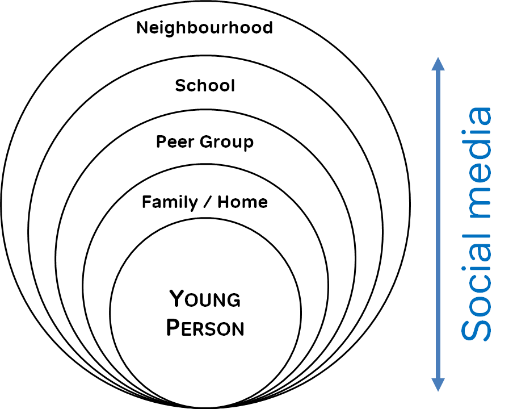
Leila Holmyard's PhD research connects directly to the complexity of the international school context and the globally mobile community. Recognizing that students in these settings face unique challenges (contexts that shift dramatically with each move, vulnerabilities related to transitions and cultural adaptation), Holmyard developed a four-component framework called "Collective Capacity for Safeguarding." This framework acknowledges the interconnected roles of staff, students, parents/families, and environment in creating comprehensive safety systems.
What This Means for Schools
Professor Firmin poses two essential questions:
What is our collective capacity to keep young people safe?
Who are the people in these spaces working to keep students safe?
These questions can push us to think beyond just responding to exploring our whole-school capacity to:
- Build comprehensive teams and structures that address safety across different contexts, including physical school spaces, peer-to-peer interactions, identity-based harm, online environments, and potential community risks.
- Recognize the particular needs of globally mobile families and students.
- Center student voice in our understanding of safety by actively listening to students as we learn about their experiences and needs and improve their safety across all the contexts they navigate.
Safeguarding Is Everyone's Responsibility
Broadening our view of safeguarding creates a foundation for schools to genuinely improve their ability to prevent harm and enhance the wellbeing of their students.
This means moving beyond viewing safeguarding as solely a response to a disclosure and the responsibility of designated protection officers or counselors. It becomes the responsibility of every adult in the building, like classroom teachers who notice changes in behavior, peer dynamics or attendance patterns, coaches who observe interactions during sports, cafeteria staff who see who sits alone at lunch, and bus drivers who witness what happens during the commute.
It also means creating systems and cultures where students themselves have a voice, so we as adults can understand, address and support their safety needs. When we embrace a broader understanding of safeguarding, we shift from a reactive stance focused on identifying and responding to harm to a proactive approach that takes into consideration factors across different contexts of a student's life.
The child who made that disclosure to me all those years ago was a defining moment. I’m grateful they felt comfortable enough with me to share what was going on but wonder if I should have seen it sooner. How many other students haven’t spoken up? How many go unnoticed? That experience drives my commitment to continually learn about the complex nature of safeguarding, both preventative and responsive, so that I can help others (staff, students, parents) feel more safe, aware, and prepared.
Every child deserves a school community equipped to prevent harm before it escalates, support wellbeing across all contexts, and create genuine safety in every space. That's the promise of comprehensive, contextual safeguarding.
To learn more about safeguarding, or to get help integrating safeguarding practices in your school, learn more about the services Andrea and Stephanie offer through REC.