Ensuring Impact Through Purposefully Designed Professional Development

By Will Coman
“Didn’t we do this already, just with a different name?”
“We’ll get trained on it, but we won’t get support to implement it.”
“It could have been a really good opportunity to focus and improve practice, but instead it will just be another certificate for the CV.”
Variations of these comments often surface before a schoolwide professional development session. They are rarely signs of apathy. Instead, they reflect uncertainty about whether the learning ahead will genuinely lead to meaningful improvement for students and teachers.
Research helps explain this skepticism, with large-scale reviews showing that much professional learning never meaningfully reaches students because it is not sustained beyond initial training (Yoon et al.).
A school leader I once worked closely with often reminded us that school culture forms whether it is intentionally shaped or not. As school leaders, we must remember that the decisions we make and the actions we take are always shaping a culture around learning.

Teacher Motivation Is Not the Real Issue
Most educators value professional growth deeply. They care about doing their jobs well, about the progress their students are making, and about creating classrooms where students feel safe, supported, and challenged.
Malcolm Knowles’ work on adult learning helps us to understand their mindset more clearly, reminding us that adults are most motivated when learning is relevant, purposeful, and connected to their lived experience.
School leadership teams need not worry about motivating and engaging faculty if they instead reflect on their own goals for planning professional development, asking:
- Has it been anchored with a clear purpose?
- Is it guided by coherent priorities?
- Are there supports in place that enable practice to develop and improve over time?
- Are we examining its impact with the same care we expect in classrooms?
Why Well-Intentioned Professional Development Breaks Down
Too often, professional development is treated as an organizational obligation rather than an avenue for growth. This is not a reflection of leaders’ commitment, but of the constraints that shape planning around the availability of presenters and school calendars rather than long-term instructional priorities.
When this happens, even with the best intentions, the course, focus, and message behind professional development can begin to drift and weaken its foundations.
This challenge is understandable given the complexity of school systems. Accreditation processes, policy changes, and shifting student needs all place pressure on even the most thoughtful planning.
In international school contexts in particular, frequent staff turnover can make it difficult to sustain professional learning agendas over time. These realities do not lessen the importance of professional development. They reinforce the need for it to be designed with greater intention and care.
We would never expect high-quality learning outcomes from lessons planned in the moments before delivery. Nor would we accept units of work without clear standards, success criteria, and planned opportunities for feedback and adjustment.
Yet professional development is rarely supported by the same shared design standards, structures, or protections that guide the learning we expect teachers to provide every day.
The question, then, is not whether professional development can be thoughtfully planned, as it already is in many schools, but how leaders can design it in ways that withstand complexity and turnover while maintaining coherence and purpose.
Designing Professional Learning for Coherence
One often overlooked way to support coherence and follow through is to be explicit with educators about the purpose of professional learning before it begins.
When teachers understand whether a session is intended to inspire reflection, build shared understanding, introduce theory, or develop concrete strategies for practice, they are better positioned to engage meaningfully. This kind of clarity helps adult learners prepare mentally for the learning experience ahead, and signals respect for their professionalism, time, and expertise.
When professional development is anchored in a clear and shared purpose, it becomes easier to design with intention rather than impulse. This way of thinking is familiar to anyone who has planned effective instruction.
Strong learning does not begin with activities for their own sake, but with clarity about purpose, deliberate choices about strategy, and reflection on what is working and what is not. Approaching professional learning through an instructional design lens supports this shift, and tools such as Dr. Katie Novak’s professional learning planning framework can help leadership teams think more deliberately about coherence as priorities evolve.
A shared purpose for professional development also shapes culture. For educators, clarity builds trust and signals that time for professional learning is protected, meaningful, and connected to longer-term goals rather than shifting initiatives.
When leaders consistently articulate and uphold this coherence, professional development is more likely to feel worthwhile and sustainable within the realities of teaching. Without this clarity, schools are more likely to chase butterflies, moving from one promising idea to the next without building the depth or consistency required for real impact and leaving teachers increasingly disengaged from the process.
From Purpose to Practice: Where Most PD Loses Momentum
Clarity of purpose alone is not enough. Teachers experience this disconnect most acutely when professional learning feels meaningful in the moment but fades without clear expectations for how it should be applied in practice.
Backward planning offers a useful strategy for addressing this challenge. By identifying what success should look like at the end of a professional development cycle, leadership teams can establish supports and benchmarks that signal whether professional learning is leading to meaningful change. Clear goals invite ongoing reflection about progress, barriers, and necessary adjustments.
Importantly, goals help ensure that professional development does not end when a workshop concludes. They create a clear connection between learning sessions and classroom practice, encouraging follow-through, dialogue, and refinement over time. When this connection is intentional, professional learning is far more likely to influence practice in sustained and meaningful ways.
Why Professional Development Activities Alone Do Not Change Practice
One of the most persistent challenges in professional development is the reliance on isolated events. Workshops are familiar, efficient, and often energizing. On their own, however, they rarely lead to sustained changes in practice. A concise factsheet from the Learning Policy Institute outlines several factors that positively influence the effectiveness of professional development and its impact on classroom practice.
High-quality professional development is systemic. It draws on multiple, reinforcing strategies that work together to support change, such as:
- Coaching
- Collaborative planning
- Modeling
- Receiving feedback
When these elements are intentionally aligned, they strengthen not only the learning itself but also the conditions needed for improvement to take hold over time.
What a school consistently prioritizes through its professional development inevitably becomes part of its culture. When learning is treated as ongoing and supported, it signals that growth is valued and expected. When it is treated as episodic, its influence on both practice and culture is far more limited.
Knowing Whether Professional Development Is Making a Difference
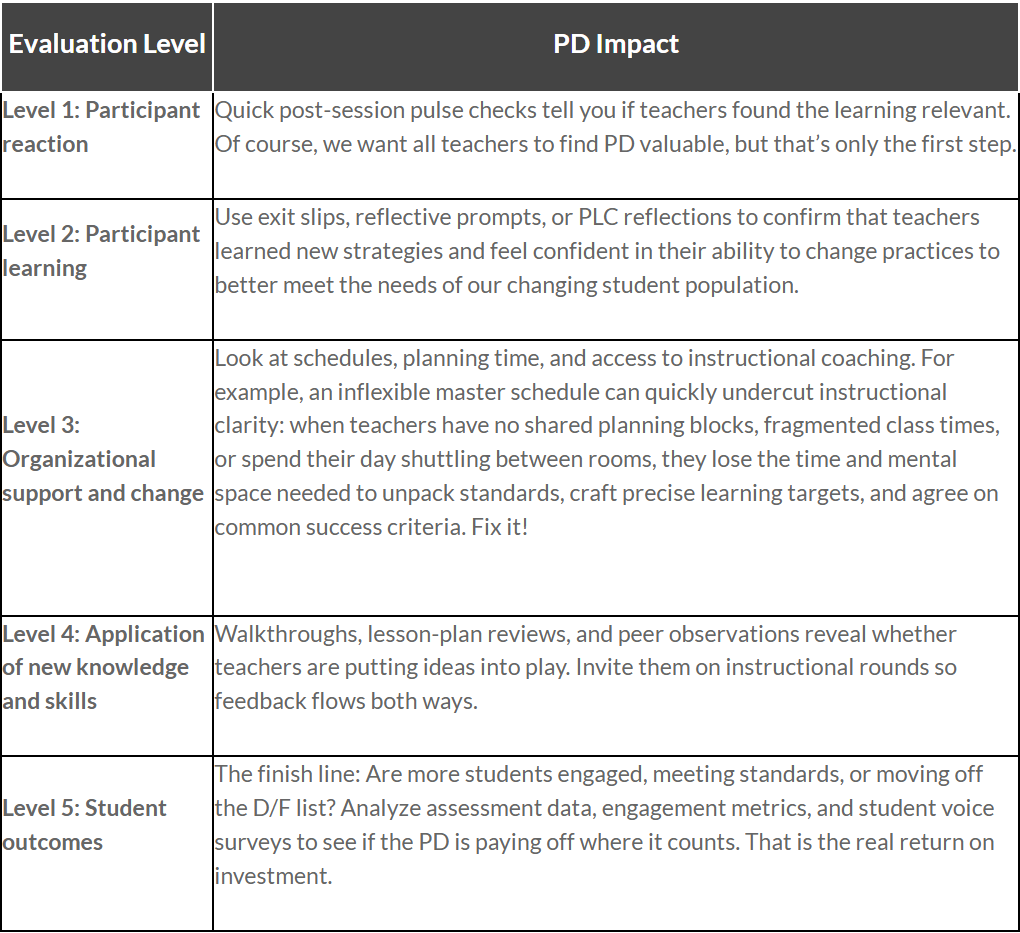
If professional development is intended to shape practice and culture, it must be examined with the same care we expect in classrooms. Teachers are regularly asked to consider the effectiveness of their instruction. Did students learn what was intended? Could they apply their learning? Did it endure? Professional development warrants the same level of scrutiny.
Too often, evaluation stops at satisfaction surveys at the end of a workshop. While educator feedback on that experience is important, it offers only partial insight into the value of the learning. Enjoyable professional development does not automatically translate into changes in practice or improved outcomes for students.
More meaningful evaluation considers evidence across time, such as changes in instructional practice, shifts in collaboration, and indicators of student learning. When leaders attend to these signals, professional development becomes a source of insight that informs what to refine, what to sustain, and what to let go in future planning.
In this way, examining professional development is not just about measuring impact, but about shaping the kind of learning culture a school chooses to build.
Leadership Discipline in a Distracting Landscape
Ultimately, purposeful professional development depends on disciplined leadership. It requires resisting the pressure to adopt every new idea, protecting focus even when change is tempting, and holding professional learning to the same standards of intentionality and evidence that are expected in classrooms.
I have come to understand my previous leader’s reminder about school culture most clearly through professional learning. The way leaders design, support, and protect professional development over time quietly shapes what a school comes to value.
When professional learning is coherent and sustained, it builds trust, shared responsibility, and a belief that growth matters. When it is allowed to drift, it sends a very different message, often without leaders realizing it.
Seen this way, disengagement is not a morale problem to solve, but feedback to listen to. Staying the course in professional learning is not simply a matter of persistence. It is a leadership decision about the culture we are shaping and the learning we are willing to protect.
References
Ashby, Anita. “Why Professional Development Needs a Plan That Works.” Novak Education, 22 Feb. 2025, https://www.novakeducation.com/blog/why-professional-development-needs-a-plan-that-works
Sutcliffe, Melanie. “The Adult Learning Theory: Andragogy of Malcolm Knowles.” eLearning Industry, 8 Aug. 2022, https://elearningindustry.com/the-adult-learning-theory-andragogy-of-malcolm-knowles
Yoon, Kwang Suk, et al. Reviewing the Evidence on How Teacher Professional Development Affects Student Achievement. Regional Educational Laboratory Southwest, 2007.
About the Author
William Coman is an educator, school leader, and consultant with 15 years of experience across a variety of settings and roles, both in Australia and internationally. He believes that all learners have the right to learn at high levels wherever they may find themselves in the world. Today, he is based in London and committed to supporting international schools in strengthening their inclusive practices through the development of Multi-Tiered Systems of Support (MTSS) and collaborative team cultures.